Kerala Assembly Election 2026 Insights
Why an app?
Politics isn't something I follow obsessively, but it's never been far from my attention. Elections, debates, the drama of it all, I find it genuinely compelling. I lean left, and that shapes how I read things, though I'm more interested in understanding what's happening than in scoring points for any side.
While following the current election coverage, I noticed something missing. There was no single place that pulled everything together in a clear, accessible way. What I wanted was simple: look up a constituency, see who's contested it over the years, how past results played out, whether it's a reliable stronghold for a particular front, or whether the last win was a quiet hold or a proper upset for the sitting MLA.
All of this information exists, mostly on Wikipedia and across different sources. But it is not easy to navigate. I often had to jump between multiple pages just to properly understand one constituency. So I decided to build something for myself. A simple one stop place where I could look up everything quickly without digging through dozens of links.
Personally, I tend to build small tools like this whenever I have a specific need. Since I started doing more vibe coding, this has become my default approach. If I cannot find an app that fits my exact requirement, I just build one.
Initial working app
Since my requirement was simple, I started with a single page app that brings everything together in one place.
It initially had these functions:
- 01Overview Page
- 02Constituency page with previous (2021, 2016) election results
- 03Analysis tab with some interesting facts I wanted to explore
Overview Page
This page mainly focuses on giving a quick snapshot of the election landscape.
At the top, there is an arc dot chart that shows:
- total seats in the past election
- seats won by each front
- party-wise seat distribution
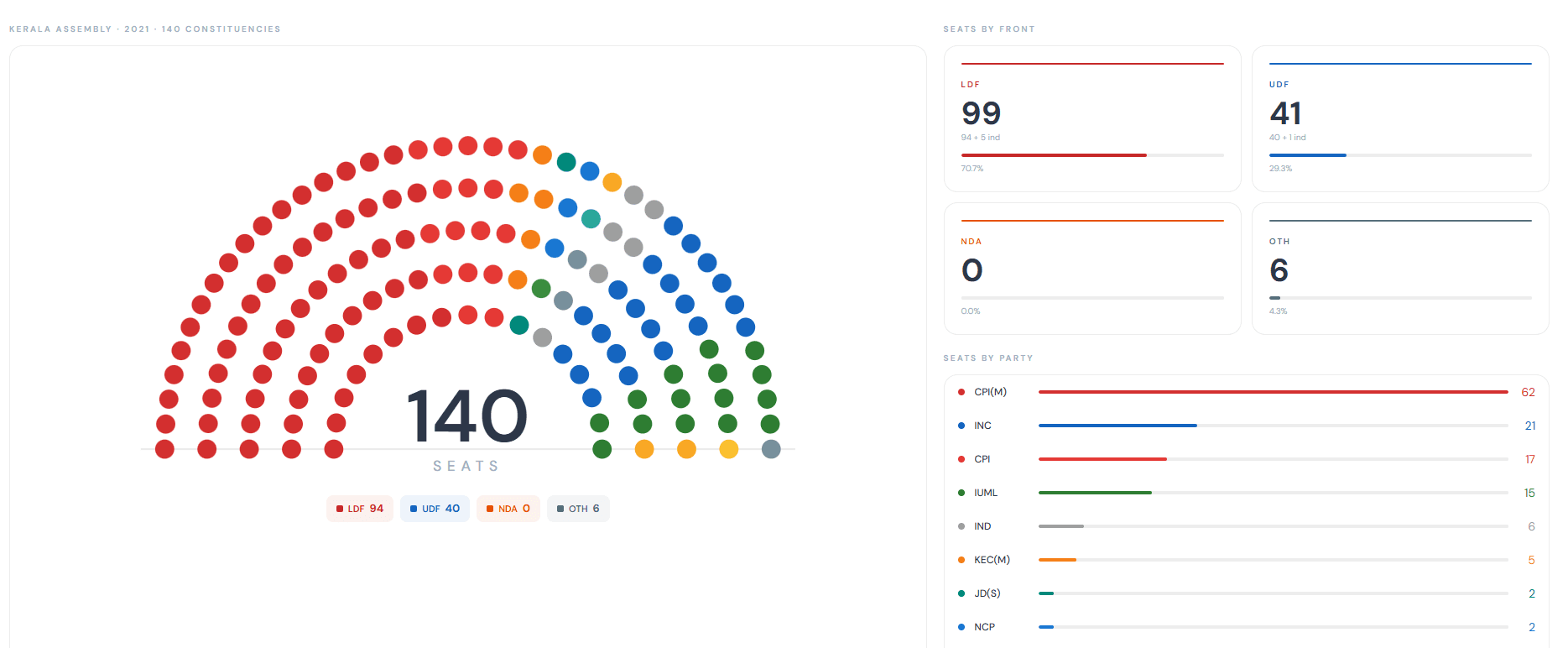
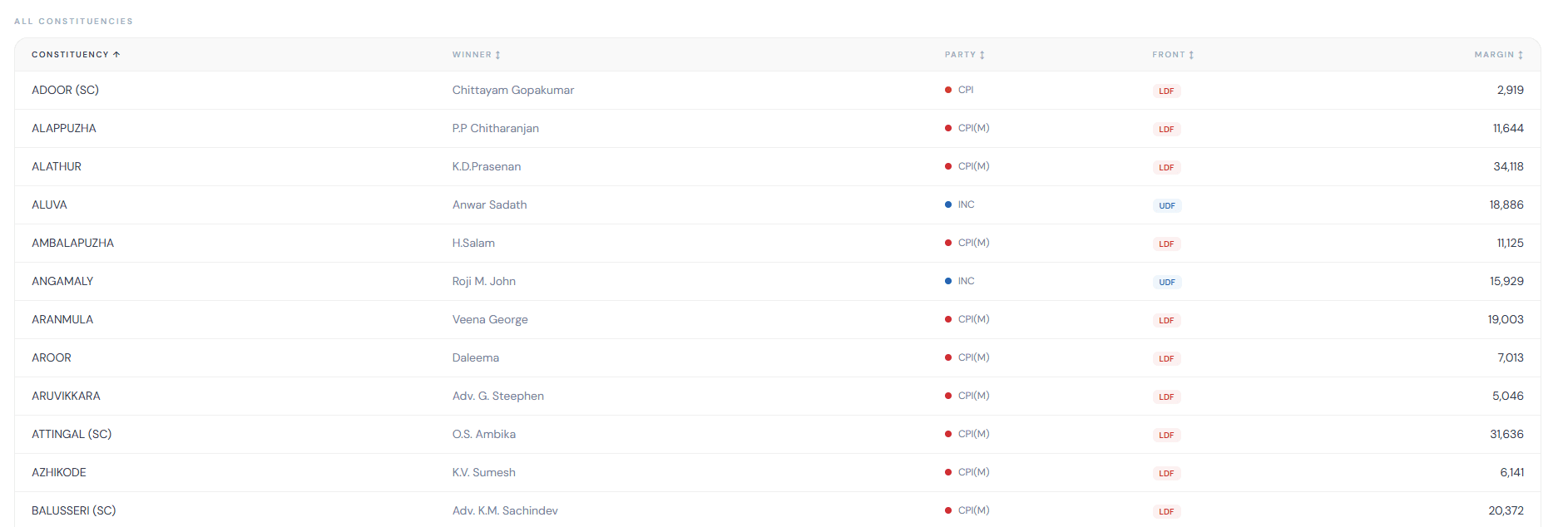
The bottom segment has a table showing all 140 constituencies in the assembly election. It includes:
- Constituency name
- Winner for the selected year
- Winner party
- Winner front
- Margin of votes
It is a fairly simple table. An important feature I later added is that clicking on a constituency drills through to the constituency tab, where it shows more detailed values.
Contituencies Page
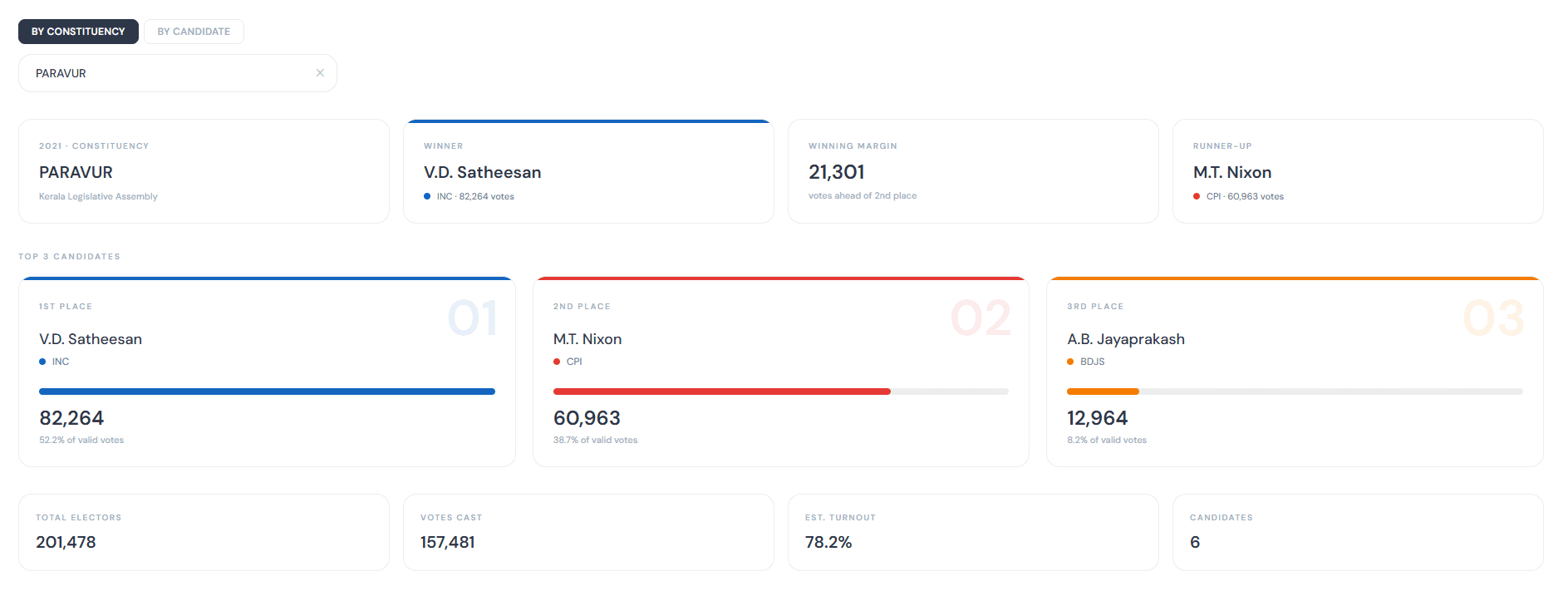
This page includes filters that make it easy to explore the data. You can filter by constituency or by candidate names from the 2016 and 2021 elections.
The page mainly shows detailed results from those elections. It includes:
- winning candidate and margin of victory
- runner up and the votes they received
- total number of voters
- total votes cast
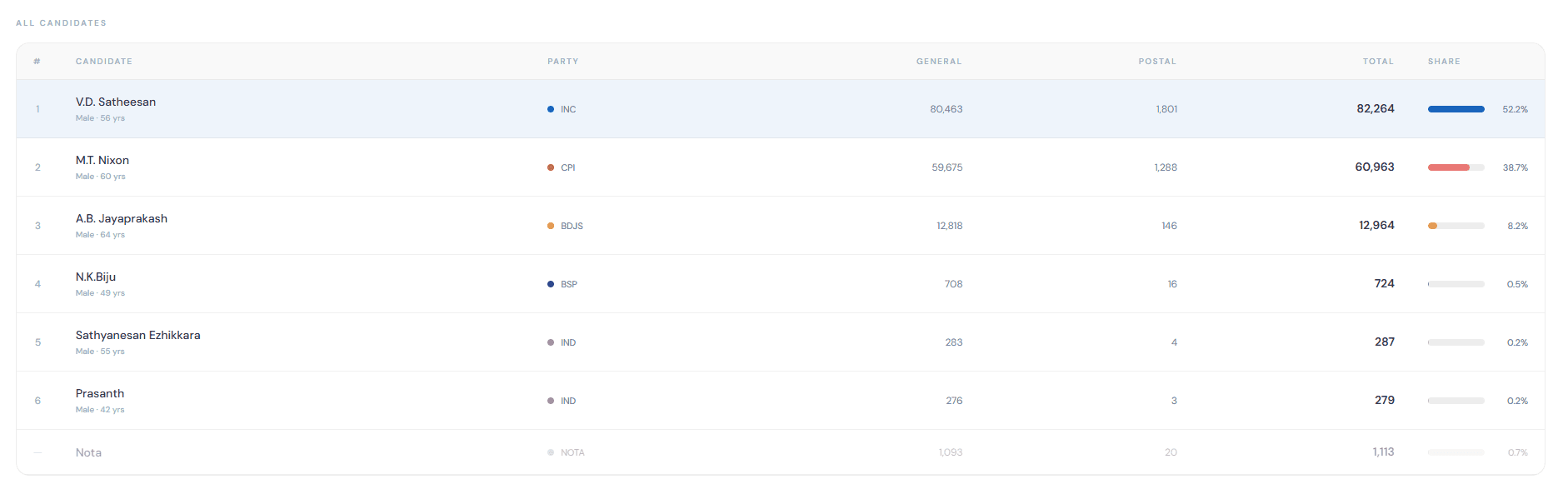
At the bottom, there is a comprehensive table that lists all candidates and the votes they received. This includes candidates from all fronts as well as independent candidates.
An analysis page
This page was added to explore some analytics from previous elections.
What I wanted here was:
- 01See constituencies that had tight margins
- 02Identify swing seats, meaning constituencies that moved to a different front, along with counts of seats gained and lost by each front
Tight margins
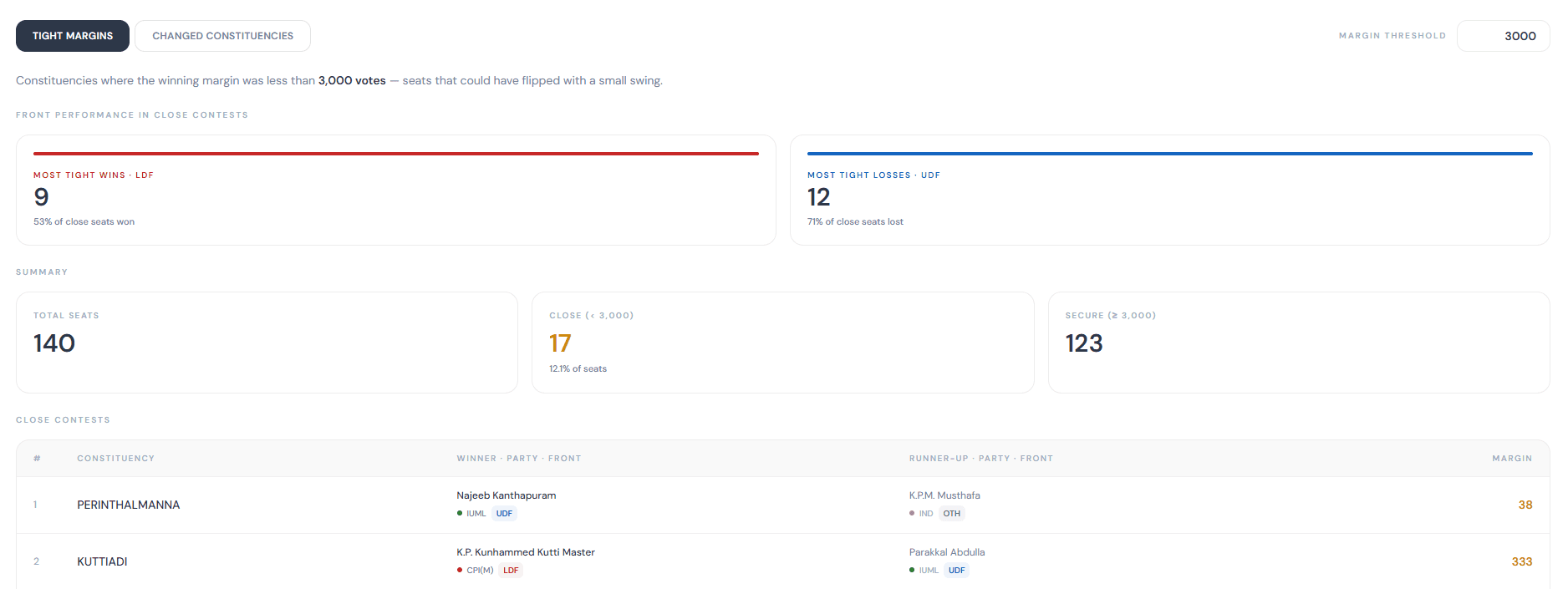
This section shows a list of constituencies with very small victory margins.
-
There is a text input that lets you adjust the vote margin cutoff. The default value is 3000, which means it shows all constituencies where the winning margin was less than 3000 votes. You can increase or decrease this value to explore more or fewer constituencies.
-
At the top, there are summary cards showing how many seats each front won within these tight margins. This gives a quick sense of which seats are more likely to flip in upcoming elections.
Another interesting angle I wanted to explore here is how fragmented the vote was in close contests. For example, in Perinthalmanna, Najeeb Kanthapuram won by just 38 votes. There were 8 candidates in total, and even the last candidate received 471 votes. Situations like this make it interesting to look at how vote splitting may have influenced the result.
Changed constituencies
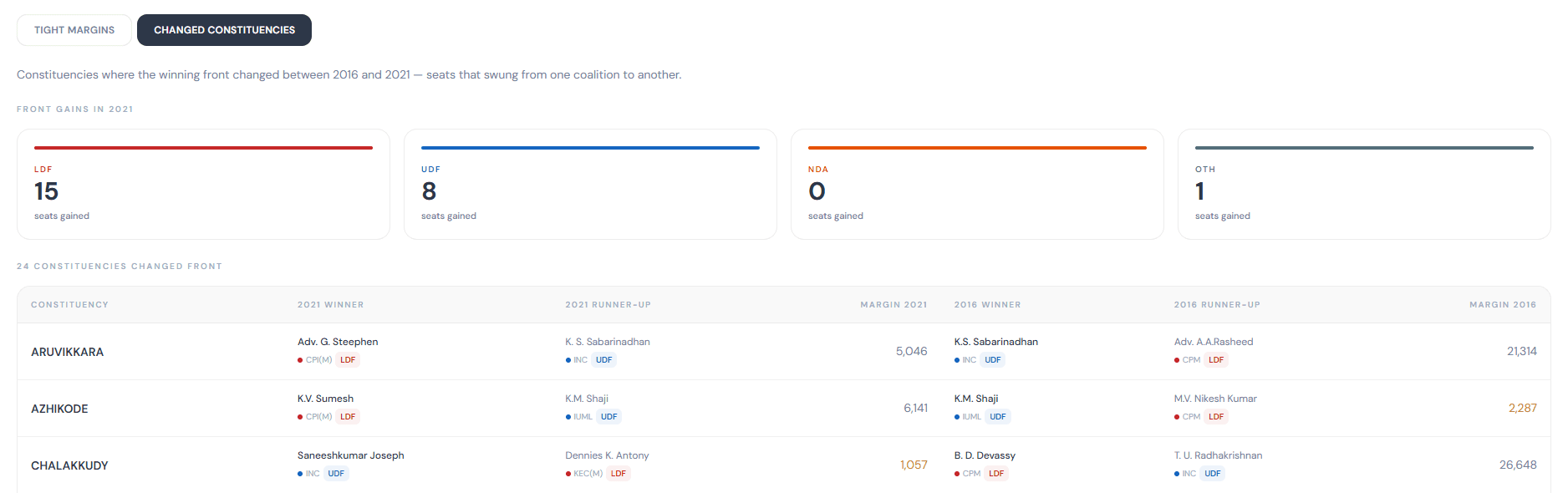
This section highlights constituencies where the seat changed hands, meaning the sitting MLA or their front lost in the election. At the top, there are summary cards showing how many such seats were gained by each front. Below that, a table provides detailed information about these constituencies and the changes observed.
Closing note
This is the first part of a series where I walk through the web app and how it works.
In the next part, I will cover:
- predictions for the 2026 elections
Each part focuses on a specific aspect of the app and how it can be used to better understand election dynamics.
If this was worth sharing, send it to someone on 𝕏 or LinkedIn. Got a question or a thought? Drop me a message , I read everything. If this was worth your time, .