My Friend Wrote About Love and Language
A friend of mine, Yahvi, wrote something recently that I keep coming back to. It is one of those posts that sits with you quietly for a few days and then rearranges how you think about something you thought you already understood.
I'm going to share the parts that stuck with me, layer in what I think about them, and try not to ruin it by overexplaining. But first , her opening line, which set the tone for everything that followed:
understanding something in the language it was written in is not the same as translating it into one that's easier to share. it loses the emotion, the weight, the nuance. it loses what makes it meaningful. it just becomes another quote.
There is an Italian saying for this: traduttore, traditore , translator, traitor. The act of translation always betrays something. The meaning crosses over, but the feeling often doesn't. Anyone who has tried to explain a joke from their mother tongue in English knows this instinctively.
But Yahvi isn't talking about languages in the traditional sense. She's talking about people.
Words english doesn't have
Here is the part that made me pause the longest. She lists the words for love across the languages she knows:
Hindi
प्रेम · prem
Pure, selfless love. Often devotional.
मोहब्बत · mohabbat
Deep romantic love. Urdu-rooted, literary.
इश्क़ · ishq
Passionate, consuming, almost divine love.
प्यार · pyaar
Everyday affection. Warm and familiar.
Spanish
amar
Deep, unconditional love.
querer
To want someone. Desire intertwined with care.
encantar
To be enchanted by. Delight and fascination.
English
love
That's it. One word. For all of it.
Look at the English column. That emptiness is the point.
There is a well-known idea in linguistics called the Sapir-Whorf hypothesis , the theory that the language you speak doesn't just describe your reality, it shapes how you perceive it. If your language gives you ishq alongside pyaar, you don't just have more vocabulary. You have more ways to feel. The categories available in your language become the categories available in your experience.
This isn't just theory. Lera Boroditsky's research at Stanford has shown that speakers of different languages literally perceive time, space, and colour differently based on the structures their language provides. Language is not a label you put on experience after the fact , it is part of the lens. The language you speak shapes the thoughts you're able to think , not just the ones you choose to express, but the ones you're able to have.
English speakers flatten love into a single word and then wonder why relationships feel confusing. Maybe the confusion was always linguistic.
Every version of you speaks a different language
This is where Yahvi's post goes from interesting to personal.
every version of me speaks a different language. i've forgotten how to understand them now, but i still get a glimpse of them in the music i used to listen to, the clothes i used to wear, the people i used to love.
A lecturer asked her class whether they would make the same decisions now as they did five or ten years ago. Yahvi's answer was immediate: absolutely not. The person she was at fifteen, the person she was two years ago , they would have ruined what she has now. Not because they were bad people, but because they were speaking a different language about what life should look like.
I think this is true for everyone, and I think most of us don't sit with it long enough.
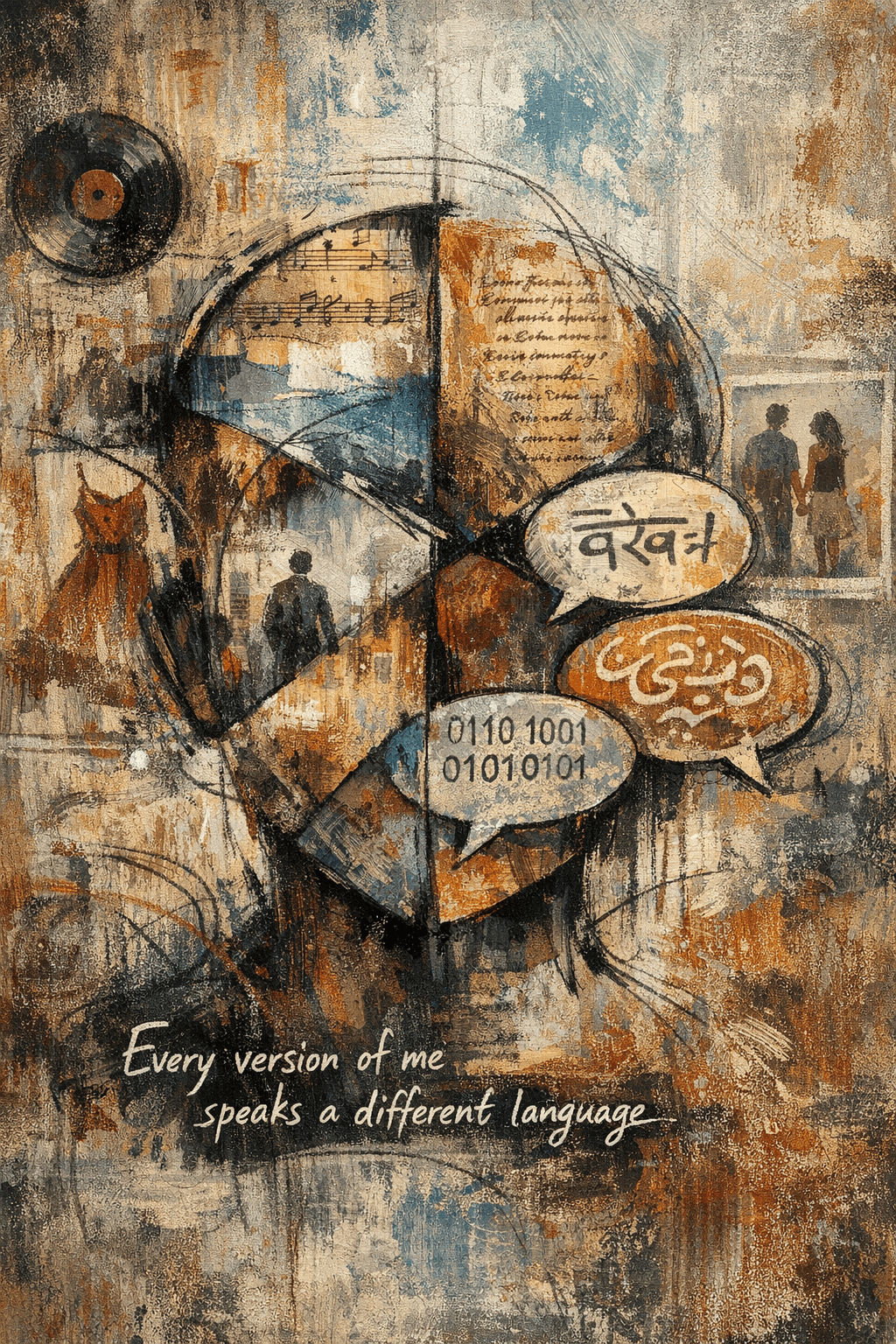
We judge our past selves constantly for decisions made with limited information. We cringe at old photos, old messages, old choices. But Yahvi's reframe is better: those versions of you were fluent in a language you've since forgotten. The love they gave, in whatever form it took, was real in the way they knew how to make it real.
Her tutor once told her: you can only do your best with the information you have at the time. Originally about clinical mistakes, but the principle carries far beyond.
How love actually shows up
Yahvi doesn't leave this abstract. She gets specific about what love looks like in practice, and this is what makes the post hit. For some people, it's words , simply saying "I love you" is enough to carry them forward. For others, it's action , making someone dinner, helping them carry a weight they had decided was hopeless a week ago. For her parents and some friends, it's understanding what they mean when they can't find the words to convey it fully.
And for some people, it's handing them a bowl of freshly deseeded pomegranate. If you know, you know.
The specificity is what makes Yahvi's writing so good. It is not a philosophy lecture about love. It is someone telling you exactly where love lives in the small, daily things.
Fluency is temporary
Here is the part I keep thinking about.
fluency in a language, in a person, is temporary. what once felt natural becomes unfamiliar again.
She draws a direct parallel between knowing a language and knowing a person. Both:
| Language | People | |
|---|---|---|
| Learned through | Immersion and repetition | Time spent together |
| Evolves | Over time, region, context | With every new experience |
| Can stem from | Emotion or logic | Emotion or logic |
| Can be forgotten | The same way it was once known | The same way it was once known |
That last row is the one that stays with you.
People you once knew like the palms of your hands no longer share your life. Not because the connection was fake, but because fluency expires when you stop practising it. The love didn't die. It just started speaking a language you stopped learning.
Maybe the issue with relationships is not a lack of depth or meaning, but a failure to find the words. Maybe the love never died , it simply took on a different language.
Dialects, not death
Yahvi saves her best idea for the end. She brings in the concept of dialects:
dialect: a form of a language which is formed over a change in time, region, or social group
Languages don't die all at once. They fracture into regional variations , the core remains, but the expression shifts. Her point: maybe she didn't lose those past versions of herself. Maybe love, as she knows it, just takes different forms. And the work is learning how to translate between them.
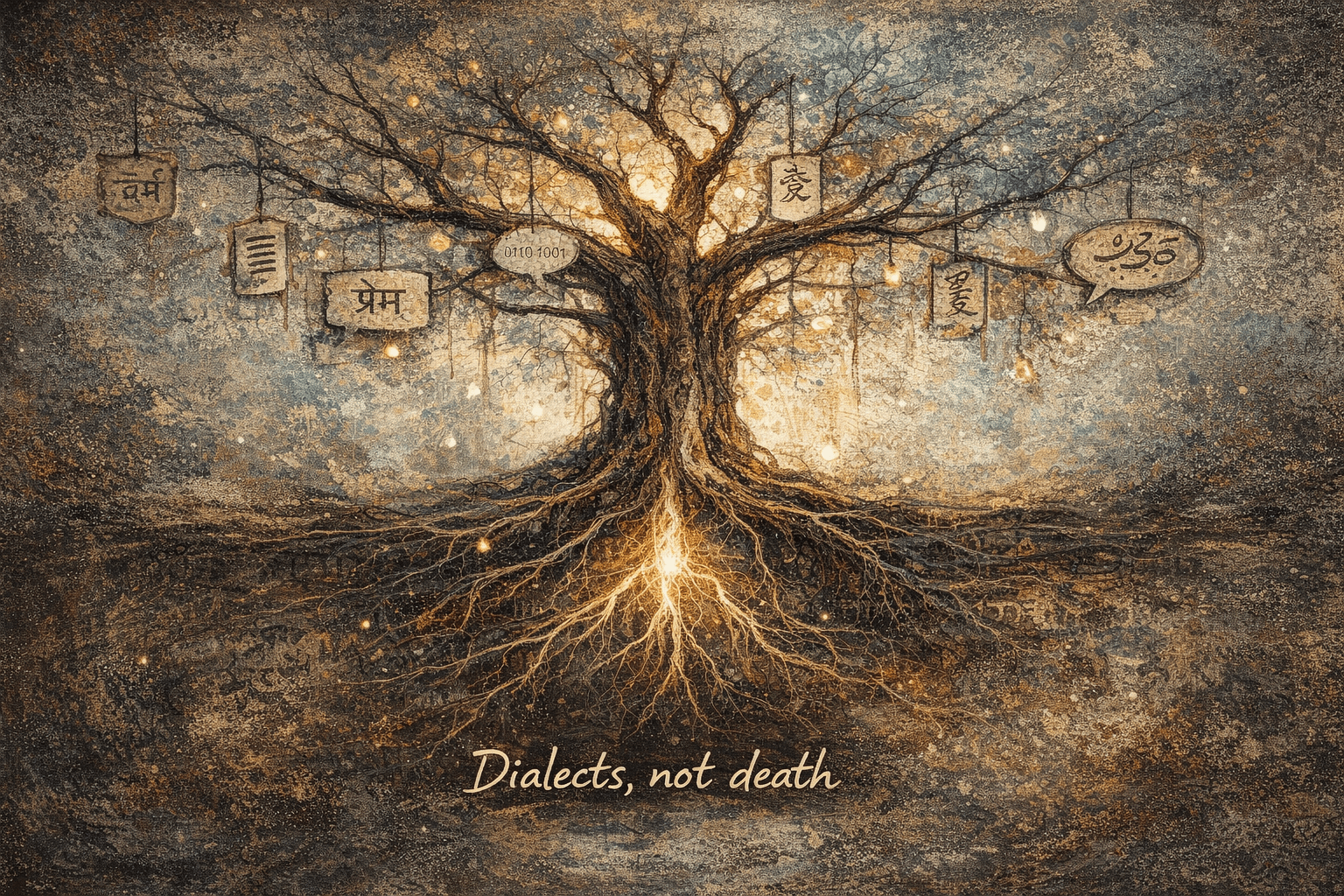
I think most of us are walking around with a handful of expired phrasebooks, wondering why our old connections feel foreign. The answer is not that the love was fake. The answer is that we stopped translating.
What I'm taking from this
Yahvi ends her post with a small, direct ask: tend to one relationship , with yourself, a partner, your parents, or a friend. Choose one, and show up for them. Learn their language.
Reading her post made me realise I've been lazy about translation. Not the linguistic kind , the human kind. I've let relationships go quiet and told myself the distance was natural, when really I just stopped putting in the effort to understand how the other person's language had changed.
So I'm going to pick one person this week and relearn them. Not by asking "how are you." By actually paying attention to what their version of love looks like right now, even if it looks nothing like it used to.
I'd recommend reading Yahvi's full post , it's better than anything I could paraphrase here. Some things really do lose their meaning in translation.
If this was worth sharing, send it to someone on 𝕏 or LinkedIn. Got a question or a thought? Drop me a message , I read everything. If this was worth your time, .