Baidu Built an AI That Reads a Whole Document Without Blinking
Here is a problem you have probably never thought about, because computers are supposed to have already solved it: getting a computer to read a document.
Not one page. A whole document. A 40-page manual, a scanned legal contract, a textbook chapter. Most OCR tools, the software that turns an image of text into actual, usable text, work by reading one page, forgetting everything about it, then moving to the next page and starting fresh. Page 40 gets read with zero memory of what happened on page 1. That is usually fine. Sometimes it is not, especially when a table, a heading, or a paragraph spills across a page break and the model has no idea the other half exists.
In June this year, Baidu released something that skips that whole problem. It is called Unlimited-OCR, and the pitch is right there in the name: instead of reading a document one page at a time, it reads the entire thing in a single pass, as if the pages never existed as separate objects to begin with.
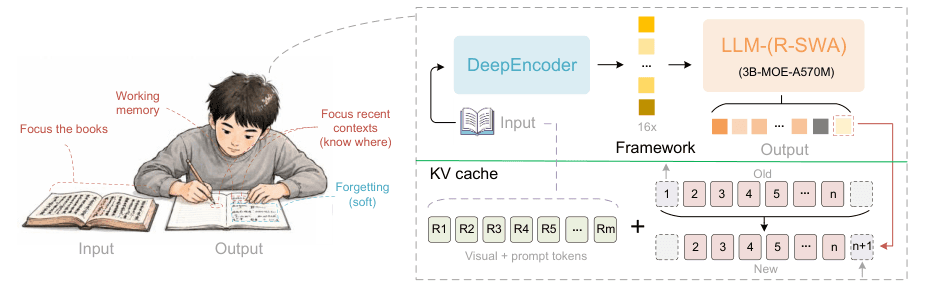
How does it read everything at once without losing its mind
Normally, the more text a model reads, the more it has to remember, and the slower and more expensive it gets. That is why page-by-page is the usual workaround, it keeps the memory small by forgetting on purpose.
Unlimited-OCR takes a different approach, something Baidu calls Reference Sliding Window Attention. In plain terms: while it is generating text, it keeps looking back at the full page image the whole time, but it only keeps a short memory of the last little bit of text it just wrote. It does not need to remember every word it output ten pages ago, because it can just glance back at the image itself if it needs a reminder. That keeps its memory usage flat no matter how long the document is, instead of ballooning the further it reads.
The surprising part
The model itself is not huge. It has 3 billion parameters on paper, but only about 500 million of them are actually doing work at any given moment, which is small by current AI standards. Small enough that Baidu says it runs comfortably on a single consumer graphics card with 12 gigabytes of memory, nothing close to the data-center hardware you would assume something like this needs.
Despite being small, it reportedly outperforms DeepSeek's own OCR model on the standard document-parsing benchmark, and the gap gets a lot bigger specifically on long documents, which makes sense, since long documents are the entire point of this thing.
Why this actually matters
Most people are never going to run an OCR model themselves. But a lot of things people use every day quietly depend on one: searchable scanned PDFs, receipt scanning apps, document upload features that "read" your file for you, AI tools that summarize a contract or a research paper. All of those get noticeably worse when the underlying model loses track of the document halfway through.
Baidu released the whole thing for free, weights and code included, under a permissive MIT license. That means any developer, not just Baidu, can drop it into their own product tomorrow. Which is probably the most Baidu part of this entire story: quietly release a genuinely clever fix to a boring, annoying problem almost everyone has run into, and let the rest of the internet figure out what to do with it.
If this was worth sharing, send it to someone on 𝕏 or LinkedIn. Got a question or a thought? Drop me a message , I read everything. If this was worth your time, .