Turns Out the Whole Internet Is Six Clicks Wide
I have been playing Wiki Race with a friend of mine, somewhere around 20-25 games at this point, and I have won most of them. Duh, obviously.
Margin's slim though, if I am being honest about it. Her brain genuinely works faster at this than mine does, she spots connections I would never think to look for. The real reason the scoreboard leans my way is that I was usually the one picking the start and end topics, which meant I had already been chewing on how to get from one to the other before the clock even started. A head start disguised as a coin toss.
What actually got me thinking, though, had nothing to do with the score. It happened at a completely unrelated moment, nowhere near a game, when I was just thinking about how the wiki solver site always caps its routes at four to six links. That number sat there for a second, and then six degrees of separation wandered into the same thought uninvited. Putting the two next to each other is what actually cracked this open for me.
The rules, quickly
Wiki Race is simple. You get a starting Wikipedia page and a target page. You can only move by clicking links inside the article body, no search bar, no typing the answer into the URL like a coward. Whoever reaches the target in the fewest clicks wins.
I first played a version of this about 7-8 years ago, during my bachelor's, at a tech fest stall. The matchup I remember was Microsoft to Apple. Thinking about it now, that is embarrassingly easy, Microsoft's page links to basically every major tech company on Earth within two clicks. A newborn with motor control and a mild interest in consumer electronics could win that round. But it felt clever at the time, and I have apparently been chasing that feeling ever since.
The version I play now, on wiki-race.com, is a lot less forgiving.
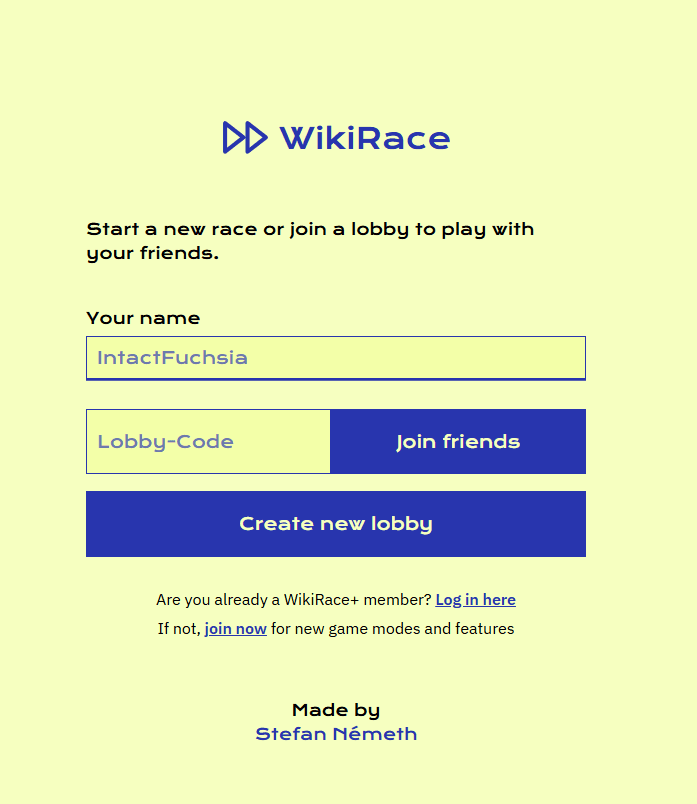
The site is built by Stefan Németh, a full-stack developer based in Munich. You pick a username, create or join a lobby, and race live from a start page to a target page. It is ad-free, donation-supported, and it just works, which after enough late-night browser multiplayer sessions is a genuine compliment. Worth a look at stefannemeth.com if you want to see what else he has built.
The way I actually play
Here is a real example. Start page: Olympics. Target page: Shashi Tharoor, the Indian politician and writer.
My route looked something like this:
Olympics → United States → India → South India → Kerala politics → notable people → Shashi Tharoor
Six or seven jumps, and honestly one of my better runs. My worse ones stretch past ten, because my brain does not path-find, it free-associates. I see "United States" and think "big country, has states, India also has states," and off I go, one geographically-adjacent vibe at a time. It gets there. It is just the scenic route every single time.
I assumed that was just what the game was, a string of educated guesses stitched together until you stumble onto the target. Then I found a website that does not guess.
The website that ruined my sense of self-worth
wiki.spaceface.dev takes a start page and an end page and hands back somewhere between one and thirty possible routes, each one capped at four to six pages.
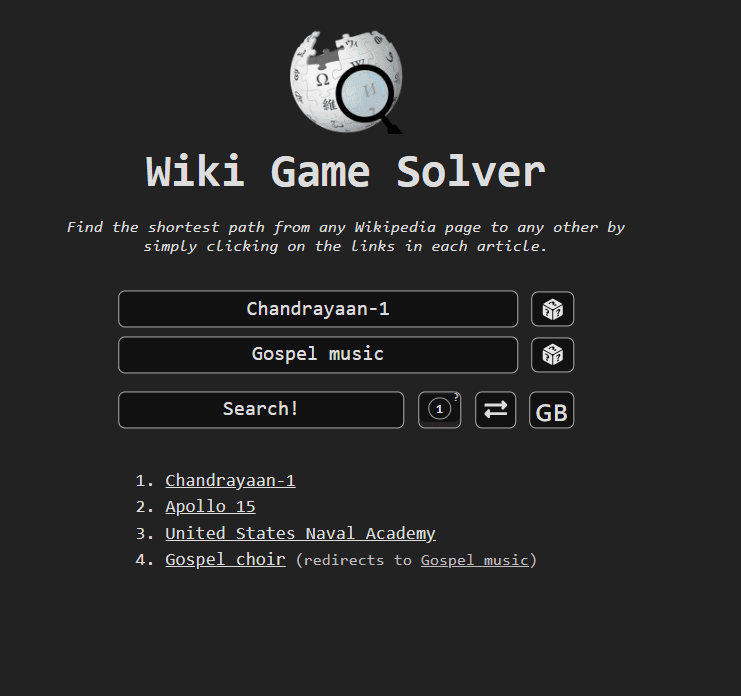
Four to six. My best human runs land around ten. It just crawls the link graph and does the pathfinding a brain has no business attempting in real time, then serves the answer up like it cost nothing. I remember staring at a five-page route between two topics I had personally taken eleven clicks to connect, filing that number away, and moving on with my day.
Six degrees, except it is the whole internet
That filed-away number is what came back to me later, at a moment that had nothing to do with Wikipedia at all. Six degrees of separation. The idea that any two people on Earth are connected through a chain of, at most, about six acquaintances.
The concept is almost a century old. Hungarian author Frigyes Karinthy introduced it in a 1929 short story called "Chain-Links," where characters play a game trying to connect any person on Earth to themselves through a chain of five acquaintances. Decades later, psychologist Stanley Milgram gave it scientific weight with his 1960s "small world" experiments, having people forward letters through chains of acquaintances toward a target stranger. Milgram's own data actually pointed closer to three links on average, but "six degrees" is the version that stuck, helped along by a Broadway play, a movie, and a Kevin Bacon party trick.
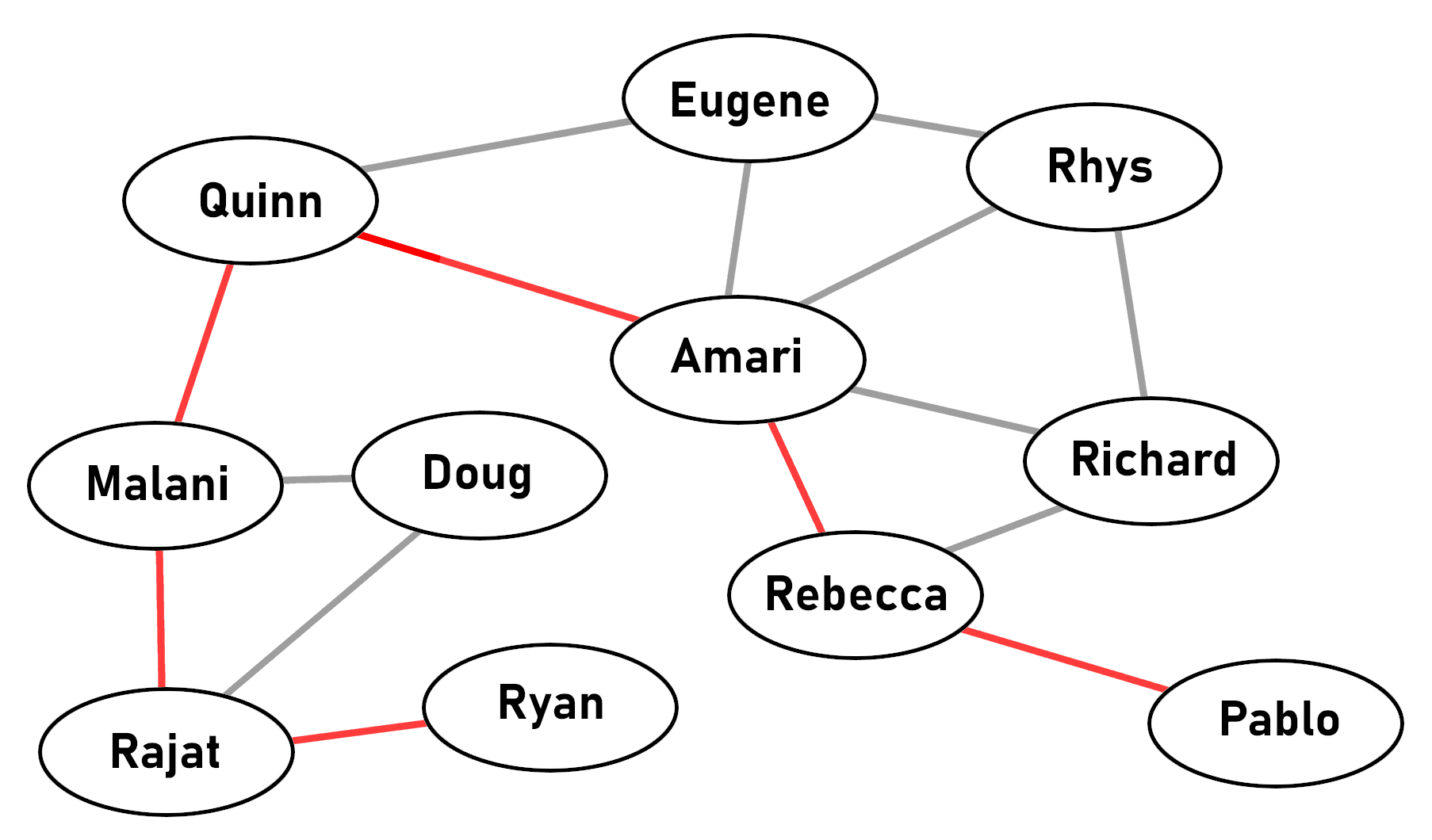
What wiki.spaceface.dev was quietly showing me, one four-to-six-page route at a time, is that the same pattern is sitting inside Wikipedia itself. Not people connected through acquaintances, but every topic humans have bothered to write an encyclopedia article about, connected through links. Nuclear reactors to Godzilla. Ancient Rome to your favorite meme. Olympics to Shashi Tharoor, in far fewer clicks than I gave it credit for.
There is even a project cataloguing this directly: Six Degrees of Wikipedia, a page full of surprisingly short chains between topics that feel like they should have nothing to do with each other. Nuclear Fusion links to Castle Bravo, which links to Godzilla. Two degrees. No detour through geography, no vibes-based free association, just two clicks between a physics concept and a giant radioactive lizard. The same page also documents outliers stretching to thirty-nine steps between two extremely obscure articles, because six degrees is an average, not a law, and somewhere in Wikipedia there are two topics that genuinely want nothing to do with each other.
But on average, it holds. Pick almost any two articles on Wikipedia, no matter how unrelated they look, and you are probably about six clicks apart. Not because Wikipedia was designed that way, but because that is apparently just what happens when you let millions of people link ideas to each other for two decades. The whole thing folds in on itself into a small, tightly connected world, the same way a planet of eight billion strangers somehow folds into six handshakes.
So what was I actually losing at
Every Wiki Race I have played was me manually, inefficiently, rediscovering that any two ideas on Wikipedia sit closer together than they look from the inside of a ten-click run. My routes were never proof the target was far away. They were proof that I take the scenic route, every time, out of instinct rather than necessity.
I did not know the Six Degrees of Wikipedia page existed until I went looking for it after the fact. Before that, this was just my own thought, sitting there uninvited on a completely unrelated day. And I am proud of it, honestly. I usually get proud over fairly simple, easy facts, the kind everyone already knows and I am just late to. This one felt different. Now I have something else to tell people at parties besides six degrees of separation. I can tell them the same thing is quietly true of every article on Wikipedia too, and watch it land the way it landed on me.
If this was worth sharing, send it to someone on 𝕏 or LinkedIn. Got a question or a thought? Drop me a message , I read everything. If this was worth your time, .