How India's North-South Divide Was Built
Tamil Nadu sends ₹4 to Delhi for every ₹1 it gets back. Bihar gets back more than it contributes. Both of those facts are true. But if you stop there, if you make that the whole story, you've already lost the plot.
The North-South divide isn't a scandal. It isn't a conspiracy. It's the accumulated output of six decades of policy decisions, some deliberate, most not, that compounded quietly until they became impossible to ignore. Two states, same constitution, wildly different economic realities. And a ticking deadline that might blow up the political balance entirely.
I want to trace this from the beginning. Not the Twitter version, not the TV debate version. The actual mechanics: where the divergence came from, how the money moves, and what a real fix might look like.
This series was heavily inspired by aevyTV's breakdown of the same topic. Go watch it. It's what got me down this rabbit hole.
This post started as documentation of aevyTV's video. I wanted this written down somewhere I could reference. It also became a workflow test: I used Gemini to do a deep research pass on the topic, which produced a sourced deep-dive document covering all three parts of this series. I then ran that through Claude to turn it into the structured, visual writeup you're reading now. Most sources are not academic. Treat this as an informed starting point, not a peer-reviewed paper.
The argument starts much earlier than most people expect. Not with the Finance Commission. Not with delimitation. With land.
The colonial hangover nobody talks about
During British rule, the Zamindari system was imposed across northern and eastern India. The mechanics of it were straightforward and brutal: landlords extracted surplus from the peasantry, sent it to Kolkata, and Kolkata sent it to London. For generations, the agrarian economy of the Hindi heartland was systematically drained of capital. No reinvestment, no infrastructure, no mobility.
That matters because land systems do more than decide who collects rent. They decide who accumulates savings, who can borrow, who can invest in irrigation, who can send children to school, and who has any bargaining power against the local elite. A society where millions of cultivators are trapped below absentee landlords does not just produce poverty. It produces weak local markets, weak state capacity, weak trust in institutions, and a politics obsessed with survival instead of long-horizon development.
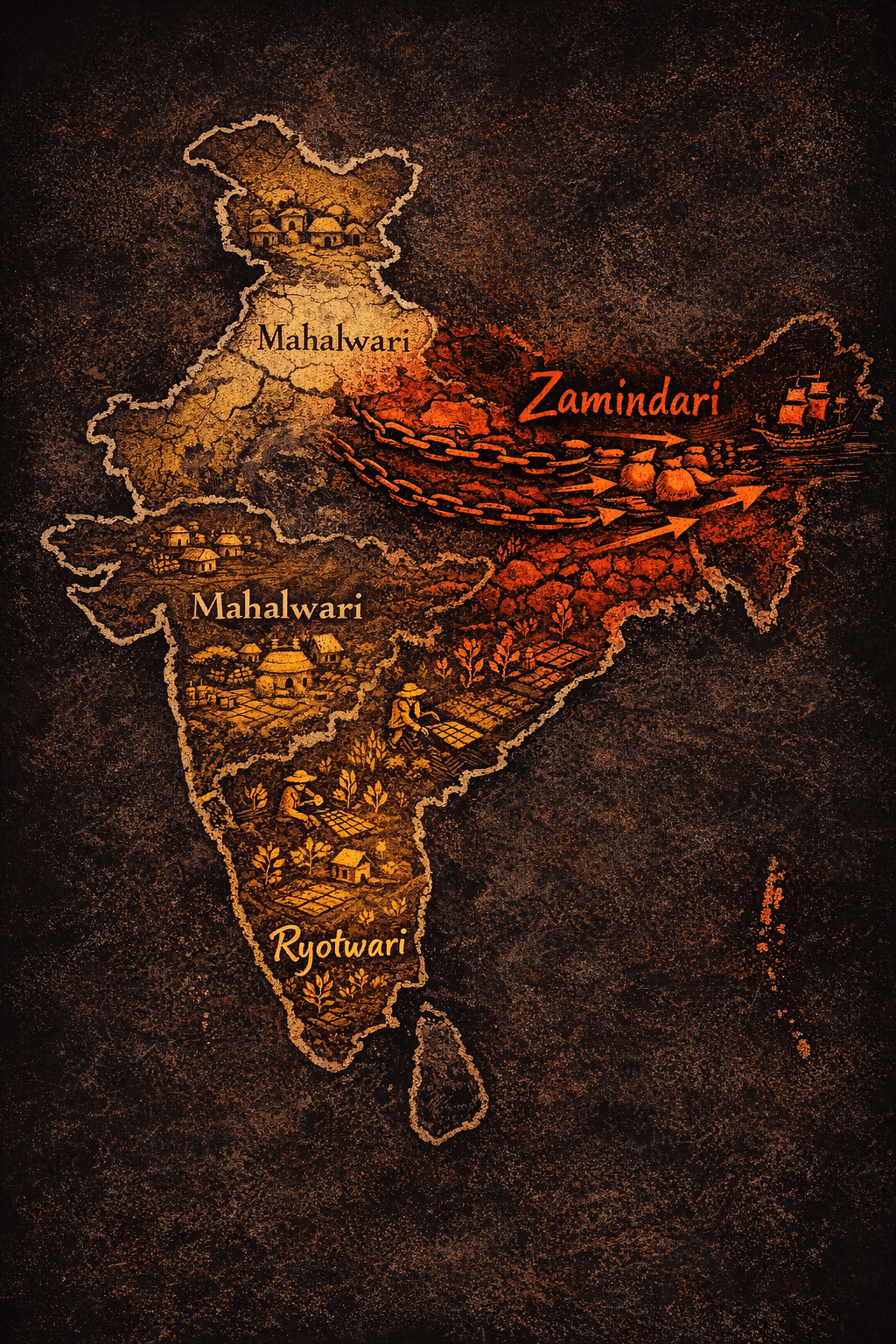
When independence came and democratic politics began, the mobilization in the North was shaped by these historical injustices. Political capital wasn't built on promises of infrastructure or industrialization. It was built on caste survival and social dignity. Leaders in states like Bihar and Uttar Pradesh rose to power on platforms of social justice and protection against historical oppressors.
And that was necessary. The dignity those movements restored to hundreds of millions of historically oppressed people was real and deeply felt. But the economic cost was catastrophic. As political energy went into social engineering and caste arithmetic, investments in schools, hospitals, and roads stalled. Capital fled. Governance decayed.
The South, meanwhile, had a different colonial inheritance. The Ryotwari system gave individual cultivators direct ownership, creating a fundamentally different relationship between people and land. It wasn't paradise, but the peasantry wasn't locked into the same feudal trap.
I want to be careful here: this is not a morality play where one region made good choices and the other made bad ones. The point is more structural than moral. When one part of a country spends generations fighting to become socially legible and politically visible, and another part gets earlier access to land-linked bargaining power and public investment, you should expect those regions to enter the post-independence era with completely different developmental starting points.
The policy that broke eastern India
Now here's the part that genuinely made me angry when I first read about it.
In 1952, the Indian government mandated that essential industrial inputs (coal, iron ore, steel) be available at a uniform price across the entire country. The government subsidized transportation costs so that raw materials from mineral-rich eastern and northern states could be shipped anywhere for the same price.
The intention was noble: balanced regional development. The effect was devastating.
To see why, you have to remember what usually gives a place an industrial edge. Heavy industry likes to be close to either raw materials or ports. If you sit on coal and iron ore, you should have a natural advantage in steel, engineering, and manufacturing. If you sit on a coast, you should have a natural advantage in exports and logistics. What the policy did was erase the first advantage while leaving the second fully intact.
Think about it from a factory owner's perspective. If coal costs the same in Bihar as it does in Tamil Nadu, why would you build a factory in landlocked Bihar? You'd go to the coast: Maharashtra, Gujarat, Tamil Nadu, Karnataka. You'd get the same subsidized raw materials plus massive ocean ports for exports.
That's exactly what happened. For 41 years, this policy systematically hollowed out the industrial potential of eastern and northern India while turbocharging the coastal states. When the policy was finally scrapped in 1993, there was no transition plan, no rebuilding fund, no compensatory mechanism for the states whose industrial futures had been sacrificed at the altar of "national balance."
This is one of those policies whose damage is easy to miss because it shows up as an absence. You don't see the factories that were never built in Bihar. You don't see the supplier networks that never formed in undivided eastern India. You don't see the skilled industrial workforce that never had a reason to cluster there. But that missing industrial ecosystem is precisely what later determines wages, urbanization, infrastructure quality, and tax capacity.
The North
Feudal hangover
Zamindari extraction → caste-first politics → governance decay. Political energy consumed by social justice battles rather than institution-building.
The East
Industrially gutted
Mineral-rich but robbed of their only advantage by 41 years of freight subsidies. Capital migrated to the coast. Never came back.
The South
Invested in people
Different land systems, early education bets, subsidized raw materials, port access. By 1991, perfectly positioned for liberalization.
What gets missed in most discussions is the compounding effect. Once industry clusters on the coast, it doesn't just create factories. It creates ports, engineering colleges, machine suppliers, industrial townships, better roads, local subcontractors, and a bureaucracy that learns how to manage investment. Path dependence kicks in. The coastal states become even more attractive precisely because they were made attractive first.
The point of this isn't to blame anyone. It's to establish that the divide was manufactured. The North didn't fall behind because its people are less capable. It fell behind because the policy environment made it structurally impossible for it to catch up.
How the South built its engine
While the North was trapped in its colonial aftermath and the East was being systematically deindustrialized, the South was making a fundamentally different bet: human capital.
Visvesvaraya and the Bangalore pipeline
In the princely state of Mysore (modern-day Karnataka), M. Visvesvaraya laid the foundation for a technological ecosystem as early as 1912. Operating under the motto "Industrialize or Perish," he spearheaded the construction of dams, mandated primary education, and established pioneering engineering colleges, including the Government Engineering College in Bangalore in 1917.
This created a multi-generational pipeline of technical talent. By the time Texas Instruments came looking for an Indian base in 1985, they bypassed Delhi entirely and chose Bangalore. Not because of lobbying or incentives, but because an entrenched, highly skilled talent pool had been producing graduates for over 70 years.
That detail matters more than it looks. Liberalization in 1991 did not magically create Bangalore. It revealed Bangalore. The city already had the engineering base, administrative habit, and talent pipeline that made global capital comfortable. In development terms, that is the whole story: reforms reward places that are already institutionally ready to absorb them.
Kamaraj and the midday meal revolution
In Tamil Nadu, Chief Minister K. Kamaraj took office in 1954 to face a state with 18% literacy. He understood something that seems obvious in hindsight but was radical at the time: building schools is useless if classrooms are empty because children are forced into agricultural labor to survive.
His solution was the Midday Meal Scheme, launched in 1956. By providing a free, nutritious lunch to every child attending school, the state created a massive economic incentive for desperately poor parents to choose education over child labor. Enrollment skyrocketed. Literacy rates nearly doubled within a decade.
The scheme was expanded by M.G. Ramachandran in 1982 and eventually adopted nationwide. The macroeconomic impact of a free lunch, genuinely one of the most consequential policy interventions in Indian history.
This is also where the South's advantage becomes more subtle than "more schools." It is one thing to construct educational infrastructure. It is another to solve the household economics that stop poor children from showing up. Tamil Nadu did the second part early. Once enrollment improves, literacy rises. Once literacy rises, especially for girls, fertility falls, workforce participation changes, and the state's long-term dependency ratio improves. A welfare intervention becomes a labour-market intervention twenty years later.

By the time India opened to global markets in 1991, the South already possessed a skilled, literate, technically competent workforce perfectly positioned to absorb foreign capital, automotive manufacturing (Ford, Hyundai, BMW), and the impending IT boom.
The North had none of this. Not because it didn't want it, but because the preconditions (literacy, technical education, industrial infrastructure) had never been built.
And that is the broader lesson: markets don't reward desire. They reward preparedness. When one region spent decades building the social base for industrialization and another spent those same decades fighting colonial residue and policy-induced underdevelopment, the divergence was always going to become visible once capital was free to choose.
Two countries, one constitution
The historical investments in education and health have yielded a demographic divergence so extreme that it's hard to believe both regions are governed by the same laws.
One in Bihar. One in Kerala. The child in Bihar is 70 times more likely to grow up in multidimensional poverty. She's significantly more likely to die before age one. If she survives, she's far less likely to finish high school, and exponentially less likely to get a formal, high-paying job. Same country. Same constitution. Radically different life.
The poverty chasm
The NITI Aayog's National Multidimensional Poverty Index 2023 makes this concrete. The MPI doesn't just measure income. It evaluates simultaneous deprivations across health, education, and standard of living.
| State | MPI Headcount (NFHS-4) | MPI Headcount (NFHS-5) | Absolute Reduction |
|---|---|---|---|
| Bihar | 51.89% | 33.76% | -18.13% |
| Uttar Pradesh | ~37.68% | 22.93% | -14.75% |
| Tamil Nadu | ~2.00% | 1.43% | -0.57% |
| Kerala | ~0.48% | 0.48% | 0.00% |
Credit where it's due: Bihar saw the fastest absolute reduction in MPI, dropping 18 percentage points. That's genuine, meaningful progress. But the baseline difference is staggering. Tamil Nadu is already at 1.43%, Kerala at near-zero. The North is improving, but it's improving from a place the South left behind decades ago.
That distinction matters. Catch-up growth is real, but it is not the same as convergence. A state can improve rapidly and still remain structurally behind if the gaps in healthcare quality, school completion, urban job creation, and state capacity remain wide.
This poverty gap translates directly into mortality. NFHS-5 data reveals that children born in UP and Bihar face drastically higher infant mortality compared to Tamil Nadu and Kerala. The southern states achieved this through robust public health spending, welfare schemes, and deeply penetrated medical services.
This is the share of people living with overlapping deprivations in health, education, and living standards. Lower is better.
■Southern states ■ Northern states
The chart above is useful because it shows two things at once. First, today's deprivation is still massively unequal. Second, the North is not frozen in place. It is moving. But the South's earlier lead means the finish line keeps shifting outward. That is the uncomfortable reality of compounding advantage.
The invisible engine: women at work
This is the factor that I think gets the least attention but matters the most.
The scientific correlation between female literacy and total fertility rates is undisputed. Higher education universally correlates with delayed marriage and fewer children. Because the South educated its women earlier, these states successfully navigated the demographic transition, bringing their total fertility rate well below the replacement rate of 2.1.
This demographic shift allowed women to enter the formal workforce at scale. In Tamil Nadu, 40% of the factory workforce is female. Think about what that means for an economy. You've essentially doubled the productive labor pool.
| State | Urban Female LFPR | Rural Female LFPR | Total Female LFPR |
|---|---|---|---|
| Tamil Nadu | 30.0% | 67.9% | 49.8% |
| Andhra Pradesh | 24.5% | 59.3% | 47.5% |
| Kerala | N/A | N/A | 36.9% |
| Bihar | 12.0% | 48.2% | 34.5% |
| Uttar Pradesh | ~14.4% | Elevated (unpaid ag) | ~32.4% |
Data from Periodic Labour Force Survey 2023-24.
This doesn't mean women in the North aren't working. Millions are engaged in unpaid agricultural labor or home-based micro-businesses. They're economically active but statistically and financially invisible, trapped in low-productivity sectors that don't grow household income, don't expand domestic demand, and don't generate tax revenue for their state governments.
This is one of the most important mechanisms in the entire story. Female literacy changes household bargaining. Household bargaining changes fertility. Lower fertility changes the amount of unpaid care work inside the home. That opens space for formal employment. Formal employment raises household income, widens the tax base, and creates political demand for better urban services. In other words, the South did not just educate women and get a moral victory. It changed the structure of its economy.
The lack of formal, high-paying jobs for women in the North isn't just a gender equity issue. It fundamentally limits the economic ceiling of an entire region. You cannot build a modern economy while leaving half your population out of it.
And once you see it that way, the North-South divide stops looking like a cultural argument and starts looking like a long-run state-capacity argument. Regions that invested early in education, nutrition, women's mobility, and basic institutional competence built durable advantages. Regions that were denied those foundations, or had them actively undermined, were left trying to industrialize and urbanize from a far worse starting point.
Where this leaves us
So that's the origin story. Colonial extraction, a catastrophic freight policy, and radically different investments in human capital (especially female human capital) created two Indias that happen to share a flag.
The North is growing. Bihar's poverty reduction numbers are real and impressive. But the structural gap is decades wide, and closing it requires more than good intentions. The compounding advantage the South built over sixty years doesn't simply dissolve because the North is now growing faster from a lower base.
This matters because the fights currently consuming Indian federal politics (over tax redistribution, over delimitation, over who owes whom what) are downstream of this history. You can't make sense of them without it.
If this was worth sharing, send it to someone on 𝕏 or LinkedIn. Got a question or a thought? Drop me a message , I read everything. If this was worth your time, .