Why India Can't Afford This Fight
The question isn't whether India has a problem. It clearly does. Two regions on wildly different economic trajectories, a redistribution system that makes the faster region feel like it's being taxed for its success, and a looming constitutional change that could strip that same region of the political leverage it needs to push back.
The question is what you actually do about it, without blowing up the federation in the process.
The answer, I think, requires solving a dual mandate: giving the North the democratic right of proportional representation while permanently protecting the South from political marginalization. If you only solve one side, you guarantee a rebellion from the other.
The grand bargain
The emerging consensus among constitutional scholars and political economists points to a comprehensive structural reform that has two pillars:
Pillar 1
Expand the Lok Sabha
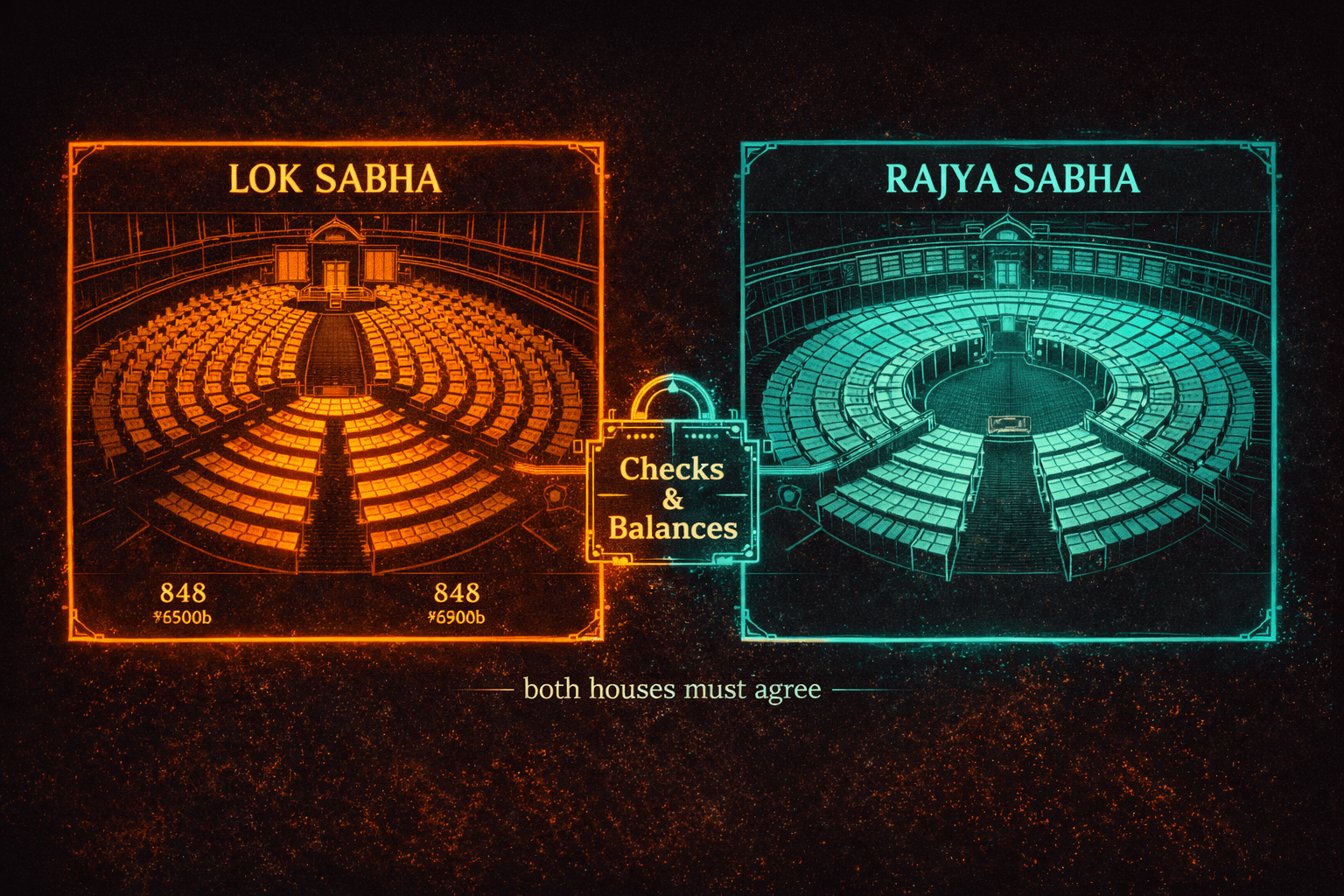
Instead of stripping seats from the South to give to the North, expand the total house to 848 or 888 seats (matching the capacity of the new Parliament building). The North gains proportional representation. The South doesn't lose a single seat on paper.
✓ Solves the democratic deficit ("one person, one vote")
✗ Southern proportional power is still diluted
Pillar 2
Transform the Rajya Sabha
Restructure the upper house as a genuine Federal Shield. Give every state equal representation (like the US Senate). Make Rajya Sabha members directly elected. Grant co-equal authority over financial legislation, including veto power over Money Bills and taxation.
✓ Permanently protects smaller/southern states
✓ Forces compromise across regional lines
Why both pillars are necessary
Expanding the Lok Sabha alone doesn't protect the South. If UP and Bihar together command 180+ seats in an 848-seat house, a northern coalition can still bulldoze legislation through. The South's absolute seat count stays the same, but its proportional power shrinks dramatically.
That distinction between absolute seats and effective power is the whole game. A state can keep every seat it already has and still become less important if the chamber grows around it. This is why so many lazy summaries of the problem miss the point. "You aren't losing seats" is not the same as "you aren't losing leverage." In coalition politics, agenda-setting power depends on your share of the chamber, not just your raw seat count.
That's where the reformed Rajya Sabha matters. Under current rules, the Rajya Sabha has negligible power over Money Bills, meaning virtually all taxation and budget decisions can bypass the upper house entirely. The Grand Bargain proposes changing this so that all laws affecting federalism, national taxation, devolutions, or state boundaries require a majority in both houses.
Even if a populous northern coalition easily passes a redistributive tax bill in the Lok Sabha, the southern and smaller states would hold the leverage to block or amend it in the Rajya Sabha. The only path to legislation would be finding common ground.
There is room to argue about the exact design. Some scholars prefer full parity between states, like the US Senate. Others prefer a model of degressive proportionality, where small states are over-weighted but not perfectly equal to giant states. I'm less attached to the exact engineering than I am to the principle: the upper house has to become a real federal chamber, not a decorative one. If it cannot meaningfully constrain fiscal centralization or majoritarian overreach, then it does not solve the southern fear at all.
Schematic rather than statistical. The point is to show which reform combinations actually solve both problems at once.
Grand Bargain: This is the only option that tries to satisfy both demands at once: democratic equality and federal protection.
Fixing the money pipeline
Resolving the political crisis has to come with a modernization of the fiscal architecture. The Finance Commission correctly uses mechanisms like Income Distance to aid underdeveloped regions. But the era of unconditional transfers (money flowing with zero accountability) needs to end.
Performance-linked grants
The 16th Finance Commission has signaled a critical shift by recommending ₹7,91,493 crore in grants for Rural and Urban Local Bodies for 2026-2031, with a formal split:
| Grant Type | Share | How it works |
|---|---|---|
| Basic Grants | 80% | Baseline funding. All eligible local bodies receive this. |
| Performance Grants | 20% | Tied to measurable criteria: local revenue mobilization, transparent auditing, infrastructure management. |
This is a paradigm shift from input-based entitlement to outcome-based governance. For the South, it introduces the fiscal accountability they've been demanding. For the North, it incentivizes the administrative reforms needed to fix what I called the "cracked clay" problem in Part 2.
The phrase performance-linked can sound like bureaucratic filler, so let me translate it into plain English. It means the center should not only ask whether money was spent. It should ask whether school retention improved, whether maternal mortality fell, whether audited accounts were published on time, whether village roads were completed to standard, whether local bodies actually raised some of their own revenue, and whether service delivery got measurably better. Those are the kinds of metrics that turn federal transfers from political ritual into institutional pressure.
Elevating performance in the devolution formula
Beyond grants, the broader horizontal devolution formula should increase weightage for demographic performance and economic contribution. If a state controls its fertility, educates its women, and generates significant tax revenue, the formula should tangibly reward that, not as charity but as recognition that these states are carrying the national economy.
Imagine a system where high-performing states like Kerala or Tamil Nadu are formally partnered with underdeveloped states like Bihar or Jharkhand. The mentoring state helps audit healthcare outcomes, monitor literacy campaigns, and share administrative best practices. If the underdeveloped state hits its developmental milestones (lower infant mortality, better school retention, transparent local auditing) the central government releases a significant performance bonus to both states. This transforms federalism from a zero-sum fight over tax rupees into a collaborative enterprise where one region's success is financially linked to another's progress.
The concept is already being tested in narrow educational initiatives like the NIPUN Bharat Mission, where advanced states assist underdeveloped regions in foundational literacy. Expanding this model to healthcare, infrastructure, and governance would be transformative.
What I like about the mentor-state idea is that it changes the emotional structure of the problem. Right now the federal conversation is framed as giver versus taker. A mentoring model reframes it as capacity-sharing with mutual upside. If Tamil Nadu's administrative knowledge helps Bihar improve school retention, and both states receive performance bonuses, then development stops looking like a punishment for competence and starts looking like a cooperative return on it.
The inconvenient truth: neither side survives alone
This is the part of the analysis that both sides of the Twitter debate conveniently ignore. The "South pays for everything" narrative is incomplete. The "North is being unfairly maligned" narrative is also incomplete. The reality is that India's regions are locked in a deep, structural interdependence that neither can escape.
The South is aging out
The demographic success of the South has created a new crisis: a rapidly aging population. Within a decade, the southern workforce will drastically shrink, leaving fewer young taxpayers to support an expanding base of retirees, a trajectory mirroring the economic stagnation that has plagued Japan and Western Europe.
Kerala already exhibits a distinct aging trend, with the highest elderly population in the country (~16.5%), further accelerated by the mass return of aging emigrants from the Gulf.
The South simply does not possess the native labor force to sustain its agricultural, industrial, and infrastructural output. It is increasingly and existentially reliant on the youth bulge of the North.
The labor pipeline that keeps the South running
The migration data here is staggering:
| Indicator | Data |
|---|---|
| Internal migrants in Kerala | 2.5 to 5 million, forming the backbone of the blue-collar workforce |
| Fisheries sector | 58% migrant workers (CMFRI data), as educated natives abandon traditional sectors |
| Source states | West Bengal, Bihar, UP, Assam. The plywood factories, agricultural fields, and construction sites of districts like Ernakulam run almost entirely on northern and eastern labor. |
| Economic impact of absence | When migrants briefly return home during state elections, southern industries face severe, immediate paralysis |
The North's demographic surplus is not just useful to the South. It is the critical, irreplaceable input for the South's economic engine.
And the complementarity runs both ways. Southern industry gets labour at the scale it needs. Northern households get jobs, remittances, and a path out of locally stagnant economies. This is why the rhetoric of mutual contempt is so intellectually weak. The South is not subsidizing a useless region. It is drawing on the labour surplus of that region every single day. The North is not leaning on a culturally alien peninsula. Its workers are already woven into the southern economy in ways that are impossible to unwind without real damage.
Food and defense
The interdependence goes beyond labor. During the food crises of the 1970s, it was the fertile plains of the North (Punjab, Haryana, western UP) that executed the Green Revolution, tripling food production and feeding the entire subcontinent. But the scientific architecture of that revolution was pioneered by M.S. Swaminathan, a brilliant agricultural scientist from Tamil Nadu. Southern intellectual capital. Northern agricultural execution. Together, they prevented mass starvation.
And then there's national security. The burden of manning India's borders falls disproportionately on the North:
| Fact | Data |
|---|---|
| Largest single-state contributor | UP: 8,425 jawans in a single recruitment cycle |
| Northern belt share | Over 25% of all soldiers selected annually come from the northern region |
| Concentration states | Punjab, Haryana, Himachal Pradesh, UP, and Rajasthan dominate recruitment and ex-servicemen populations |
While the South disproportionately funds the national treasury and drives technological innovation, the North disproportionately mans the borders and ensures territorial integrity. A sovereign nation's survival requires both.
The South increasingly runs on workers from the North and East. This is not cultural rhetoric. It is a labour-market fact.
What I actually think
I started this series wanting to understand why the "North vs South" debate gets so toxic on the internet, and I think I've figured it out: both sides are correct about their specific grievance, and both sides are wrong about the other's irrelevance.
The South is right that its fiscal contributions are enormous, the accountability of recipients is abysmal, and the looming delimitation threatens to make it politically voiceless. These aren't manufactured grievances. They're structural realities backed by hard data.
The North is right that it was historically exploited by colonial systems and catastrophic central policies, that its people deserve proportional democratic representation, and that its young workforce is literally keeping the southern economy alive. These aren't excuses. They're facts.
The question isn't "who subsidizes whom?" The question is: can this republic design institutions sophisticated enough to manage the asymmetry without tearing itself apart?
The Grand Bargain (expanding the Lok Sabha for democratic proportionality, transforming the Rajya Sabha into an impregnable federal shield, introducing performance-linked grants, and building collaborative mentoring paradigms) isn't a theoretical exercise. It's a survival plan.
India's enduring strength lies in its profound, inescapable interdependence. The aging, capital-rich South absolutely requires the labor and youth of the North. The underdeveloped, populous North desperately requires the capital, technology, and governance models of the South.
Recognizing and institutionalizing this symbiosis isn't idealism. It's the fundamental prerequisite for sustaining the economic momentum, democratic legitimacy, and political unity of the Republic.
That, more than anything else, is where I end up landing. The right response to asymmetry is not denial and not resentment. It is architecture. Better institutions. Better incentives. Better constitutional design. If the republic can build those, the North-South divide becomes governable. If it cannot, the divide stops being a noisy internet argument and starts becoming a much more dangerous political fact.
The delimitation clock is ticking. The question is whether we're mature enough as a federation to build something better than what we have, or whether we'll let this fracture into the kind of regional animosity that can't be walked back.
I know which outcome I'm betting on. I just hope the people making the decisions are paying attention.
If this was worth sharing, send it to someone on 𝕏 or LinkedIn. Got a question or a thought? Drop me a message , I read everything. If this was worth your time, .