Where India's Tax Money Actually Goes
Every functioning federation has a redistribution problem. The question is never whether to redistribute: it's how much, by what formula, and whether the formula is honest. In India right now, all three of those are genuinely contested. And layered on top of the fiscal fight is a political one: a constitutional deadline that could permanently reshape which regions hold power in New Delhi.
This is where the North-South divide stops being historical and starts being live.
How India redistributes its money
Every functioning federation takes money from richer regions and sends it to poorer ones. The US does it. Germany does it. India does it. The principle is sound. You can't have children dying of malnutrition in Bihar while Bangalore builds its fifth tech park. Some redistribution is not just fair, it's morally necessary.
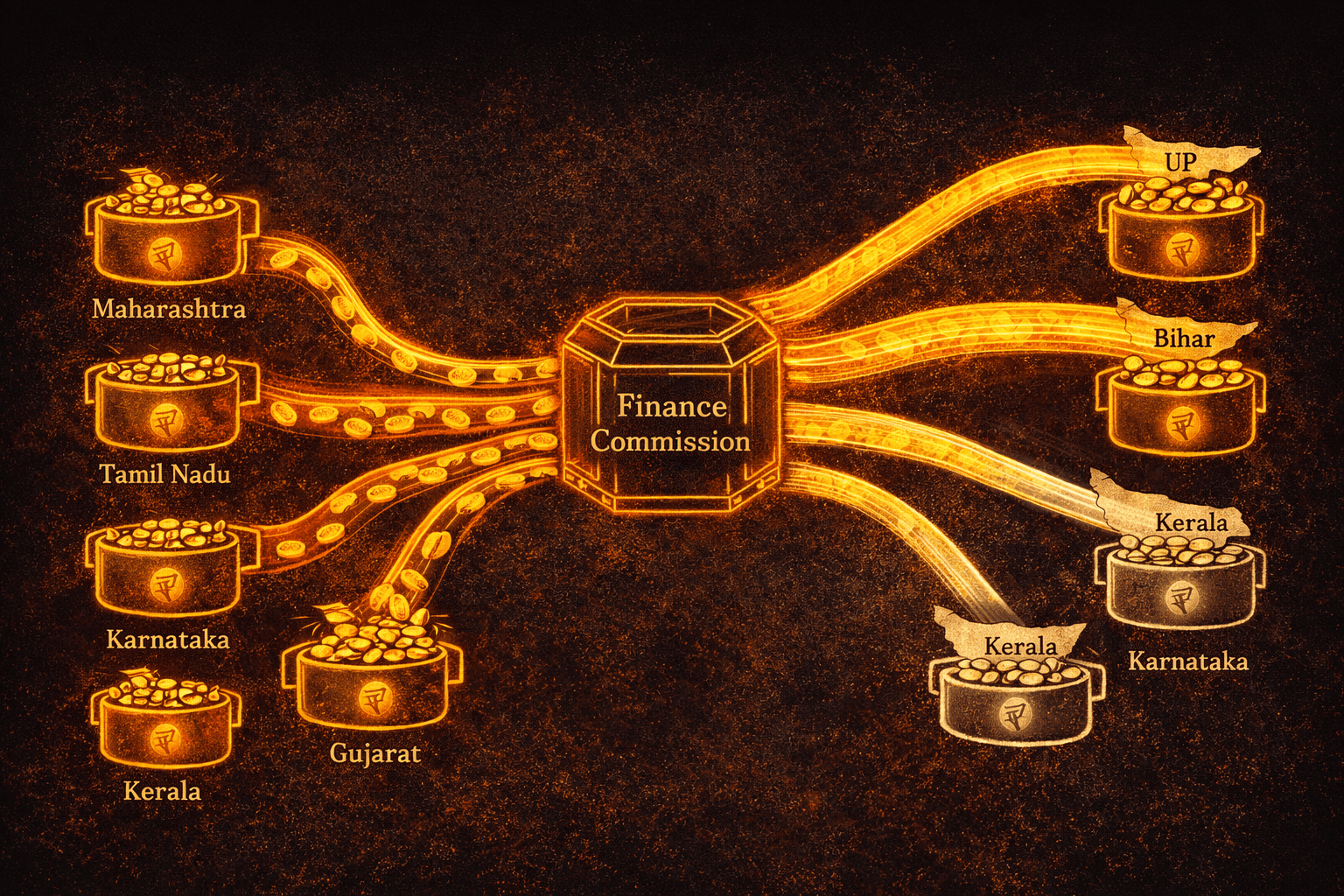
The mechanics in India work like this: the central government collects taxes (income tax, corporate tax, GST), removes various cesses and surcharges that it keeps entirely for itself, and the remainder becomes the "divisible pool". The Finance Commission then determines two things:
- Vertical split: How much goes to the center vs. the states (currently ~41% to states)
- Horizontal split: How that state share is divided among 28 states + 8 UTs
The second part is where the fight is.
That phrase, "divisible pool," sounds dry, but politically it is everything. States are not merely arguing over what share they get from a transparent common bucket. They are also angry about how much money never enters that bucket in the first place because the Union increasingly relies on cesses and surcharges, which are not shareable. So even before the formula begins, there is already a perception that the center is narrowing the pool and then asking states to fight over what remains.
And it's worth being precise here: the taxes are pooled nationally. This is not a case of Tamil Nadu sending "its own money" to Delhi and then asking for it back intact. That would be a bad way to run a federation. The problem is subtler. A few states generate a disproportionate chunk of the national tax base, but the formula that redistributes that money is built overwhelmingly around poverty and population, not contribution or performance. That is how equalization is supposed to work. The argument is over how far it should go, how long it should last, and what accountability should come with it.
The formula that fuels the resentment
The horizontal devolution formula is weighted heavily toward equity, meaning it deliberately favors poorer, more populous states. That's the point. But the scale of the asymmetry has become a source of deep southern frustration.
| Criterion | Weight | What it does |
|---|---|---|
| Income Distance | 45% | The farther a state's income sits below the richest state, the more it gets. Massively favors Bihar, UP, MP. |
| Population (2011) | 15% | More people = more money. Again favors the North. |
| Area | 10–15% | Larger states get more. Favors Rajasthan, MP. |
| Demographic Performance | 12.5% | Rewards states that controlled fertility. Favors the South. |
| Forest & Ecology | 10% | Compensates states maintaining forest cover. |
| Tax & Fiscal Effort | 2.5% | Rewards states that collect their own taxes efficiently. |
Data from Finance Commission reports.
Look at that weighting. Income Distance alone is 45%. The criterion that says "the poorer you are, the more you get" carries almost half the total weight. Combined with the 15% for population, the formula overwhelmingly benefits the North.
And to be fair, there is a real ethical case for that. If Bihar is poorer than Tamil Nadu, equalization should help Bihar more. That part is not controversial to me. The controversy begins when equalization turns into a near-permanent architecture in which the same states contribute disproportionately, the same states receive disproportionately, and the improvement in outcomes remains too slow to justify the scale of the transfer. At that point the argument is no longer equity versus selfishness. It becomes equity versus institutional effectiveness.
The result: Uttar Pradesh commands over 17.6% of the national share, Bihar nearly 10%, while Kerala (despite generating significant economic output) receives just 2.38%.
The 16th Finance Commission has added a 10% weightage for GDP contribution, which is a nod toward efficiency and economic output. But in a formula still dominated by Income Distance at 45%, it's more of a symbolic gesture than a structural correction.
What this looks like per rupee
This is the part that politicians love to weaponize, but the underlying math is real:
Slide to see how the per-rupee return changes at different contribution levels.
Right column shows what each state gets back for every ₹100 it puts in. ■Southern states ■ Other states
The five southern states (Tamil Nadu, Karnataka, Kerala, Telangana, and Andhra Pradesh) collectively contribute over a quarter of the central tax capacity but receive proportionally fractioned returns. For every ₹100 a Tamilian or Kannadiga puts into the central pool, they get back ₹30 to ₹50. A Bihari taxpayer gets back ₹250 to ₹300.
Those ratios are exactly why this debate gets emotionally loaded so quickly. The southern grievance is not simply, "we pay more." Every advanced region in a federation pays more. The grievance is that the asymmetry appears open-ended. If a state controls fertility, educates its people, formalizes its workforce, and expands its tax base, it still finds itself structurally penalized by the very formula that is supposed to reward national development.
The cracked clay problem
Here's the thing: I actually support fiscal redistribution as a principle. A nation that lets its poorest regions rot isn't a nation worth defending. But redistribution is predicated on an assumption: that the transferred wealth will generate tangible progress.
This is where the southern grievance goes beyond math. The core frustration isn't the redistribution itself. It's the outcomes.
Funds redistributed to the North have historically functioned like water poured into cracked clay, yielding negligible infrastructural or social dividends due to corruption, state-capacity deficits, and fractured governance.
A functioning federation requires built-in accountability. When southern tax rupees fund ghost schools or collapsed bridges in the Gangetic plains, it's not merely a loss for the South. It's a tragic failure for the marginalized citizens of the North whom those funds were meant to uplift.
The devolution formula has historically lacked stringent outcome-based conditionalities. Money flows in, but nobody measures whether infant mortality dropped, whether literacy rates rose, whether functional infrastructure actually got built. That's the gap. Not "should we redistribute?" but "are we checking if the redistribution works?"
And I think this is where a lot of bad debates go wrong. People collapse everything into corruption, as if the entire problem is just theft. Corruption is part of it, obviously, but state capacity is the deeper issue. You can send money into a system that lacks administrative bandwidth, procurement discipline, monitoring, and local institutional trust, and still fail even without spectacular corruption. That is what I mean by cracked clay: not only leakage, but an inability to convert spending into durable capability.
The constitutional time bomb
Everything I've described so far, the tax asymmetry and the accountability deficit, is painful but manageable. What comes next is existential.
In 1976, facing explosive population growth, the Indian government froze Lok Sabha seat allocation at the 1971 census. Southern states were told: your success in population control won't be punished with a loss of political representation. This freeze has maintained federal peace for 50 years. It expires after the next census post-2026.
Why the freeze happened
In the 1970s, India was staring at a Malthusian crisis. Female literacy is the primary driver of fertility reduction, and the southern states, leveraging their early investments in education, successfully brought their birth rates down. The North, lagging in education and health infrastructure, kept growing.
In a democracy, population equals political power. Southern leaders immediately realized that their demographic discipline would be rewarded with a loss of parliamentary seats. The 42nd Constitutional Amendment froze the allocation based on 1971 numbers, essentially promising that there would be no political consequences for controlling your population.
For fifty years, this held. The South grew economically dominant. The North grew demographically massive. An uneasy equilibrium was maintained.
But the freeze produced a different distortion in the meantime: malapportionment. A voter in Uttar Pradesh today has less effective parliamentary weight than a voter in Kerala because the constituency map did not grow with population. That means the northern grievance is not imaginary either. The current arrangement under-represents large northern populations in the name of protecting federal balance. So the real conflict is not fairness versus selfishness. It is one kind of fairness colliding with another.
The math of unfreezing
The freeze is legally mandated to expire following the first census after 2026, triggering a delimitation exercise to redraw parliamentary constituencies based on current demographic realities.
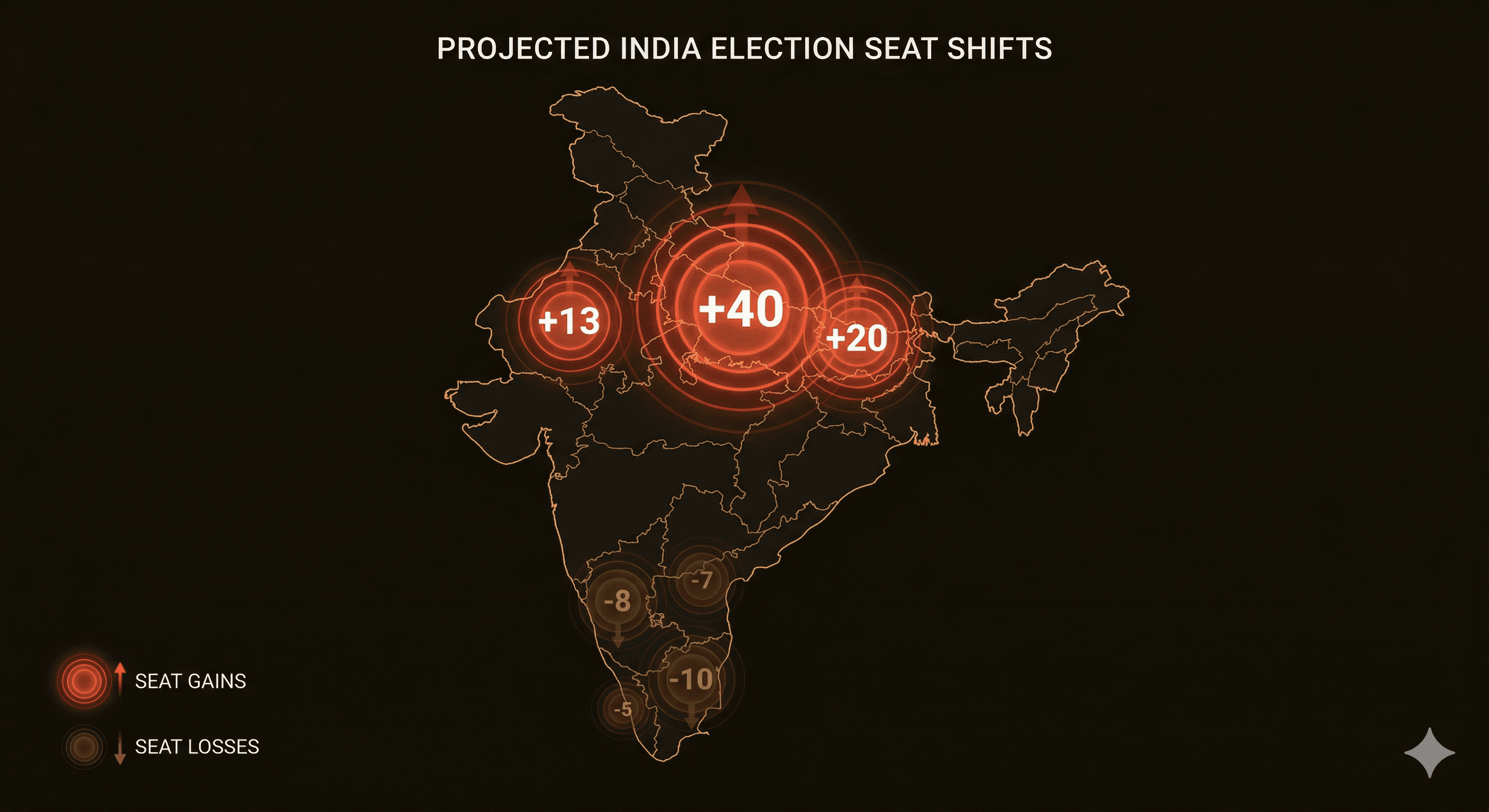
The projections are terrifying for the South:
And this is not just about bigger numbers on a seat chart. More seats means easier majority formation. It means more committee chairs. It means more influence over cabinet composition, budget negotiations, constitutional amendments, and the entire tone of national politics. A region that loses relative seat share is not merely losing prestige. It is losing bargaining power in the only chamber that can make and unmake governments.
Seats locked since the 42nd Amendment. Southern states retain representation despite lower population growth.
■Southern states ■ Northern / Eastern states
Under strict proportionality, Uttar Pradesh could jump from 80 to 120 seats. Bihar from 40 to 60. Meanwhile, Kerala could lose a third of its proportionate representation. The five southern states together could see their relative voice dramatically diluted.
What this actually means
If such a redistribution occurs unmitigated, the political voice of the South would be effectively neutralized. A national government could secure a commanding absolute majority by sweeping the Hindi heartland, without needing to win a single constituency, or even campaign, in the southern peninsula.
The regions generating the bulk of the nation's wealth would have no say in how that wealth is governed or taxed. For southern leaders, this isn't a policy dispute. It's an existential threat: the complete erasure of their region from national decision-making.
That is why delimitation has become the accelerant for every other grievance already in the system. Redistribution becomes harder to tolerate if the recipients will soon dominate the chamber that writes the redistribution rules. Poor accountability becomes harder to tolerate if the states carrying the tax base are simultaneously losing their ability to negotiate terms. The constitutional crisis isn't one issue. It's the interaction of multiple unresolved asymmetries hitting at once.
This transforms the fiscal dispute from a complaint over tax ratios into a battle for regional survival.
The two problems are connected
Here's what took me a while to see: the tax resentment and the delimitation crisis aren't separate issues. They're two faces of the same structural failure.
The South is being asked to:
- Fund the underdeveloped North through progressive redistribution (fiscal)
- Lose political power to the very states it's subsidizing (delimitation)
- Accept that the funds it sends generate weak accountability and poor outcomes (governance)
Any one of these alone is manageable. All three simultaneously is a recipe for a constitutional crisis.
In Part 3, I'll look at what the actual solutions might be, including a proposed "Grand Bargain" that tries to solve both the democratic deficit and the federal imbalance at the same time, and why the North and South are far more dependent on each other than either side wants to admit.
If this was worth sharing, send it to someone on 𝕏 or LinkedIn. Got a question or a thought? Drop me a message , I read everything. If this was worth your time, .